
Reflections on the Innovation Process
Reflections on the Innovation Process
An interpretive model born from the experience of a deep-tech startup, where the speed at which knowledge is generated is a matter of survival
Technological knowledge
A recent exchange of views on hydrogen prompted me to write this article, returning to a question I have been asking myself for years and that we have often discussed within the Keydro team: how much of our assessment of technologies depends on what we know today?
Hydrogen is an energy carrier that is complex to handle and, in many applications, still expensive. It is reasonable to believe that, in the current technological and economic context, its most concrete uses are industrial ones, particularly where it enters directly into production processes. This is also the direction in which we have steered Keydro’s research and development.
These assessments are based on the technological performance we know today. Research can change the underlying assumptions on which we estimate the economic viability of a technology, opening up possibilities we could not even consider before: the evolution of photovoltaics, in both performance and cost, has overturned judgments that seemed definitive twenty years ago. The same logic underlies the targets that the US DOE sets in many energy fields: goals that are unattainable today, which guide research by pushing it to move closer to them.
We had a direct example of how new technological knowledge can reshuffle the cards with our reactors. We had designed them for hydrogen storage and controlled release, but during experimentation we realized that they could open up alternative solutions in other fields as well, such as synthetic methane production.
A research path launched to solve a specific problem generated a new intelligence-knowledge cycle, opening a branch away from the original path.
In a deep-tech startup, experiences of this kind are everyday occurrences, and they raise two questions:
- how to assess branches, which can be fundamental but also dangerous because of their intrinsic tendency to draw focus away from the original research path;
- how not to lose the value of newly acquired or perceived knowledge.
Seeking an answer to these two questions opens a third, which lies at the heart of this article and encompasses them: how to accelerate the generation of new technological knowledge in a deep-tech company without compromising its reliability and without losing research focus.
From Information to Knowledge
Today we have access to an enormous amount of information that we often cannot process and manage: information is easy to find, yet few innovate. The leap occurs when intelligence manages to identify relationships, draw inferences and formulate hypotheses that can be put to the test.
To describe this process, based on the evidence gathered during our research journey, I propose a model built on five elements: human intelligence, information, inferences and hypotheses, development and experimentation, new knowledge.
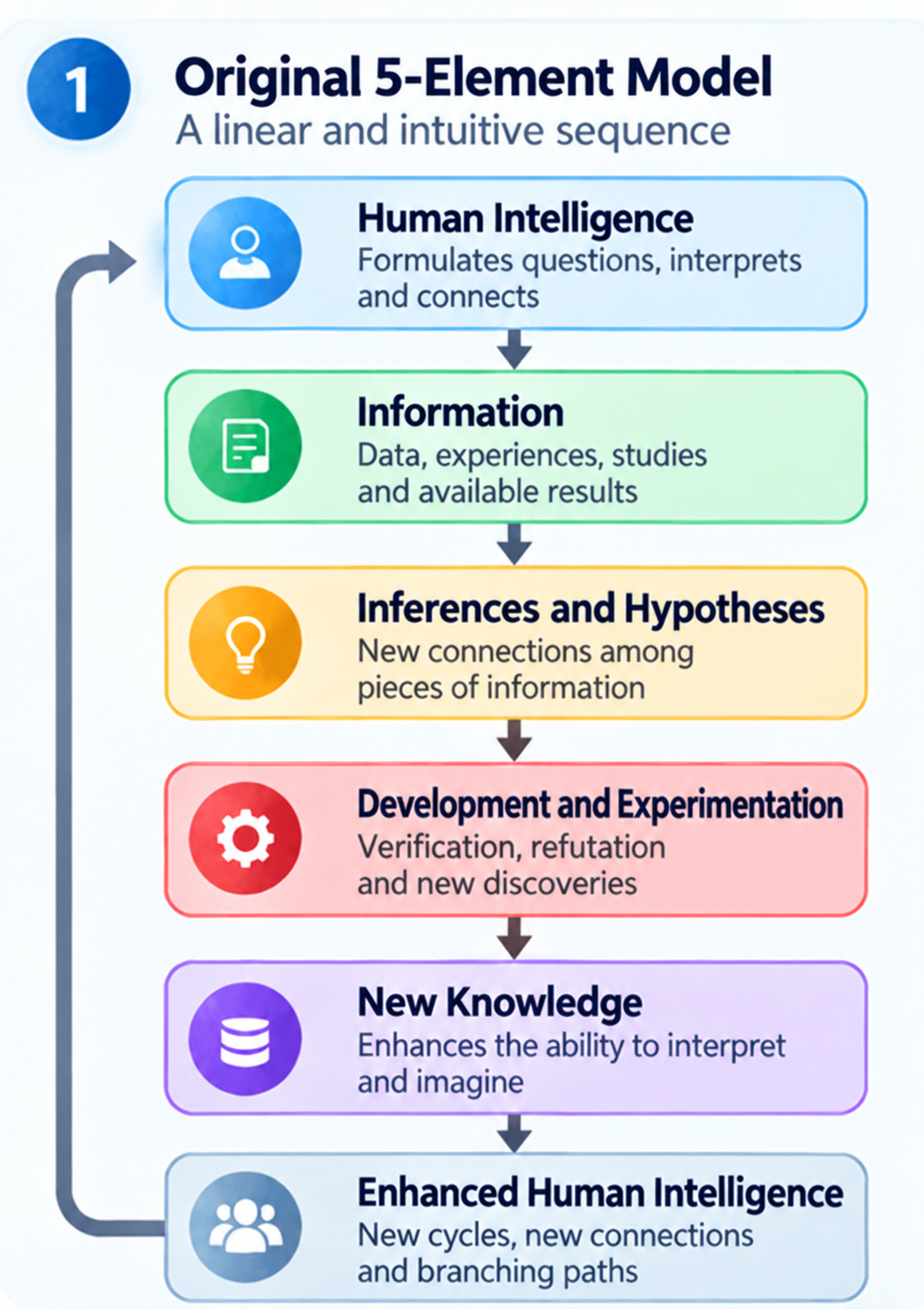
It is easy to see that, once new knowledge has been acquired, it enriches our ability to interpret, assess and imagine. This is where the cycle feeds itself, leading us to formulate questions and recognize possibilities that previously escaped us.
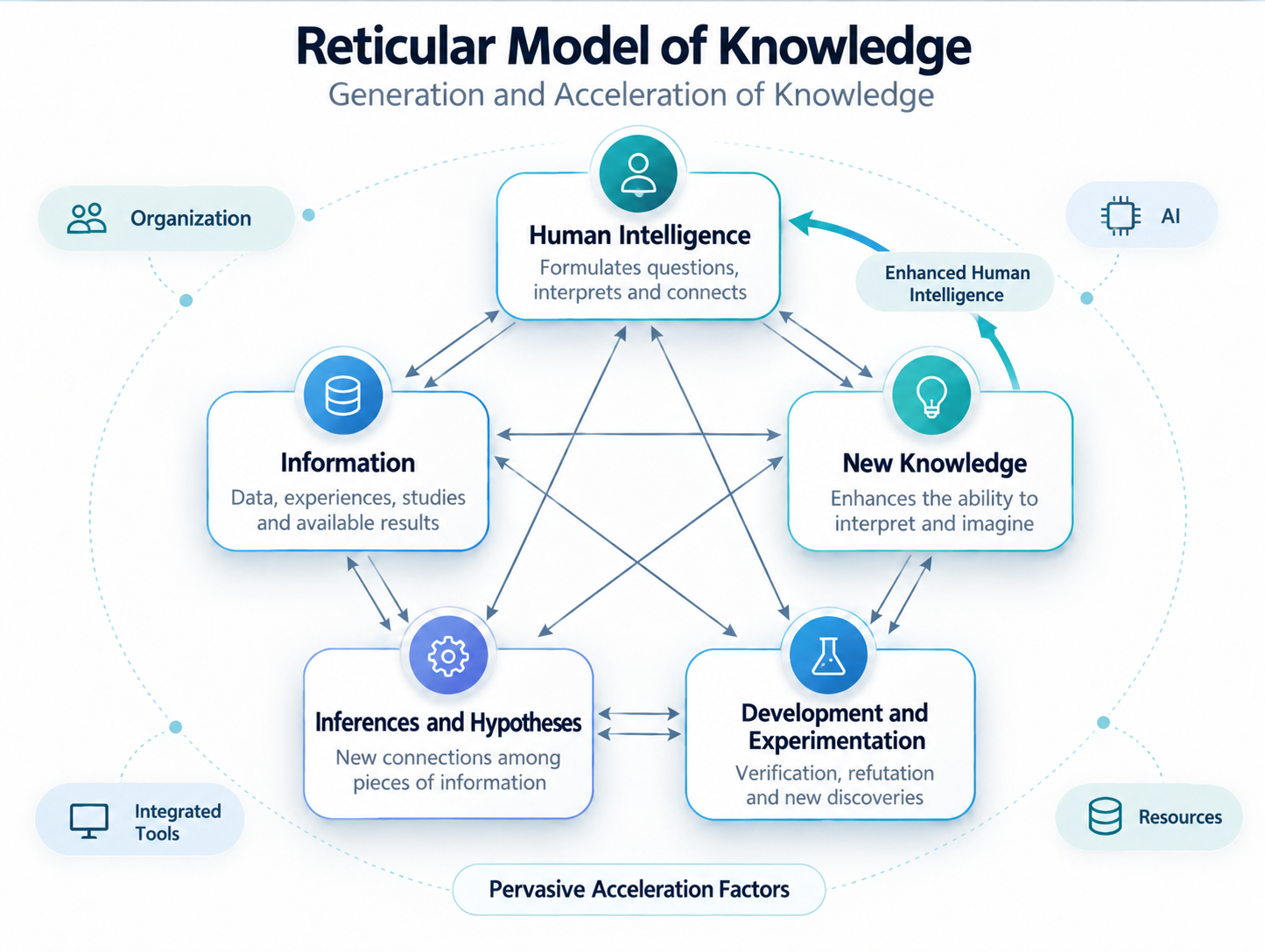
Over these years, experience has led me to think of the linear intelligence-knowledge model in a more “dynamic” way, which I call reticular, because the five elements interact continuously, in multiple directions and even simultaneously. An unexpected result can change a hypothesis, a simulation can guide new tests, newly acquired knowledge can lead us to reread earlier data in a completely different way.
Connection Is the Pivot
This is the decisive step. New knowledge does not arise from the mere accumulation of information, but from the connections we formulate, the questions we ask ourselves and the hypotheses we test. By connection I mean any relationship we hypothesize between data, phenomena or pieces of knowledge that can be put to the test: not the arrows of the model, but what travels along them, namely the hypotheses formulated, the evidence gathered and the steps that lead to new conclusions.
A new idea prompts us to gather information, information suggests hypotheses, hypotheses call for evidence. Sometimes, however, the process is reversed: a new piece of evidence – a result that works – needs to be explained, and from there hypotheses are formulated and supporting findings are sought. In the first case, what emerges is theoretical knowledge awaiting experimental verification; in the second, applied knowledge awaiting an explanation. In both cases, much of its value lies in the paths taken, not only in the points of arrival.
Some connections are confirmed, others refuted, others still change meaning as new evidence emerges. The answers to the two questions raised at the outset rest on this: documenting connections so as not to lose knowledge, assessing them to decide which branches to pursue.
This is why preserving the outcome of an experiment is not enough. It is important to also document the relationship we hypothesized, the evidence supporting it, the test carried out, the conclusion reached and the reasons for any subsequent revision. Even a disproved explanation, if the test is rigorous, becomes part of our knowledge base.
From sequence to network: the three models compared
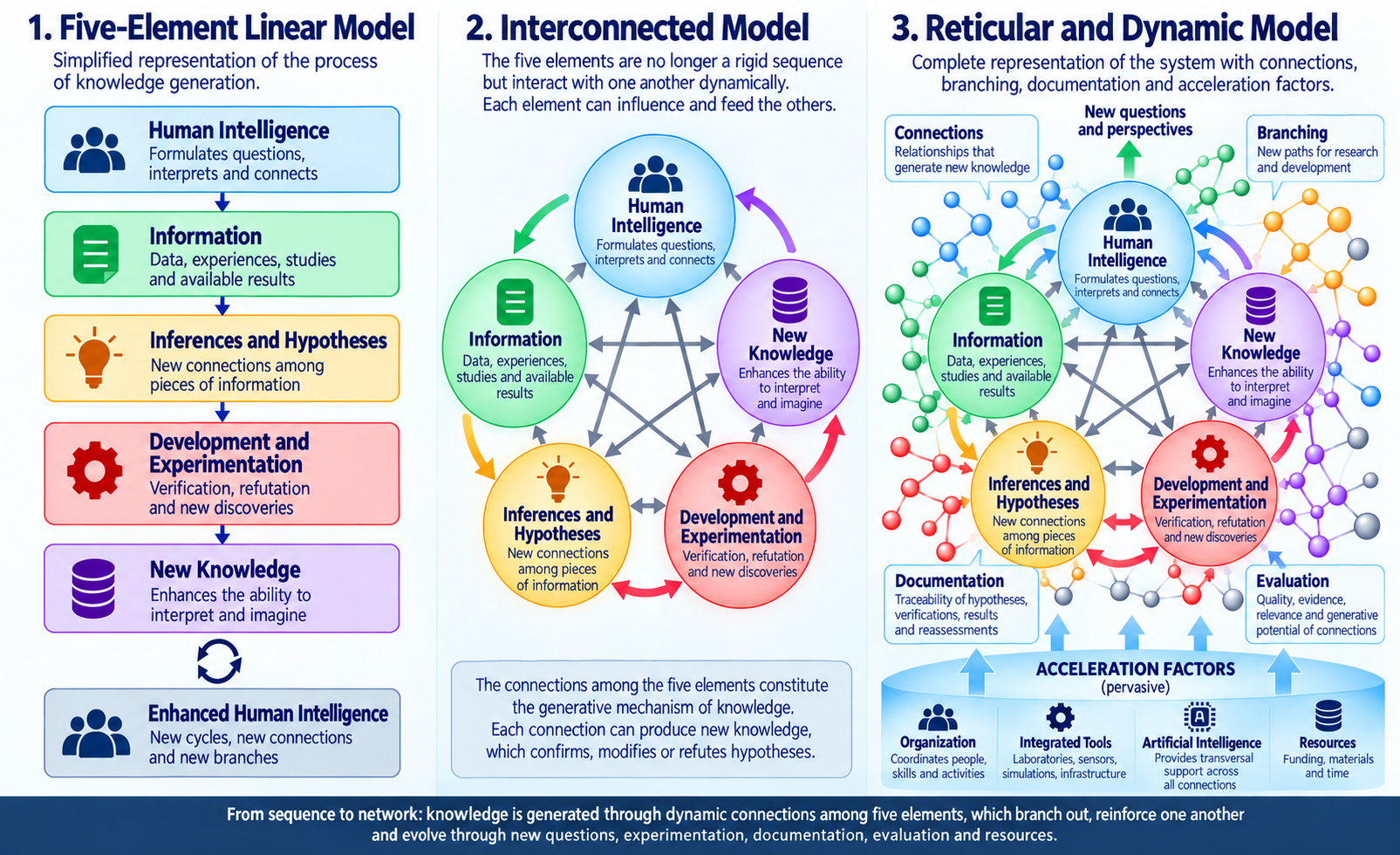
Connections can be assessed by strength of evidence, relevance, originality and ability to open further paths. Their history must remain accessible, because what seems marginal today may take on a different meaning tomorrow. Not all imagined connections are already knowledge, let alone verified knowledge: the possibility of correcting them is an integral part of the process.
Creativity, from this perspective, is not a separate moment. It is present whenever we question a hypothesis, reconsider a result or discover an unexpected relationship. The cycle does not close in on itself: it becomes a network of spirals and branches involving individuals, research groups, companies and, through the dissemination of knowledge, society.
What We Have Learned at Keydro
I would like to offer a concrete example, without going into the proprietary details of our technologies. In our research on solid-state hydrogen storage systems, we hypothesized and tested four different ways of transferring energy to the materials.
Thanks to the development of in-house instrumentation and the integration of different skills, we moved from an initial pace of about one experiment per month to sessions in which we could carry out about fifteen experiments per day, three days a week, over two weeks: roughly ninety tests.
This does not mean that knowledge grew at the same pace as the tests: we did, however, greatly increase our ability to explore hypotheses. Some results we interpreted correctly, others, initially, we did not. We therefore repeated tests and checks until we understood that in some cases energy transfer was taking place differently from what we had hypothesized.
That correction proved decisive: it became part of the knowledge that allowed us to set up the first generation of our reactors. It was also a choice of focus: we concentrated resources on one approach, while the other three remain documented, together with the hypotheses and tests carried out, as research directions to return to when time and resources allow. They are suspended branches, and therefore still open.
Generating Knowledge and Accelerating It: Two Distinct Domains
This experience led me to break down the third question raised at the outset into two distinct domains:
- how new knowledge is generated through the interaction among the five elements of the model;
- how to accelerate this process without sacrificing its reliability and without losing research focus.
Organization, availability of resources, technological tools and artificial intelligence are not additional stages of the model, but pervasive factors capable of making the interactions among all its elements more effective.
Returning to the example of our reactors: sensors and data-acquisition software provide real-time data, enabling almost instantaneous preliminary analyses; subsequent simulations help generate hypotheses, sometimes alternative ones, which new experiments take up and put to the test. These are activities that communicate with and feed one another.
AI can facilitate access to information, the search for inferences and the reading of results, without replacing experimental verification. Likewise, sophisticated tools are not enough if the organization cannot integrate them; and even an efficient organization faces concrete limits when the necessary capital, equipment or time are lacking.
From the example of the ninety experiments, we can derive three measurable phenomena and one criterion for assessing the quality of connections:
| Phenomenon | What can be measured |
|---|---|
| Speed of experimentation | How many tests we can carry out per unit of time |
| Evolution of connections | How many connections are confirmed, refuted or reinterpreted |
| Knowledge generation time | How long it takes to reach reliable conclusions and make them available for further work |
| Criterion | What to assess |
| Quality of connections | Originality, strength of evidence, relevance and ability to generate new connections |
Acceleration, from this perspective, is the change in these indicators over time: more tests per unit of time, more verified connections, less time to reach reliable conclusions. These indicators are not enough to assign a value to each piece of knowledge, but they make its evolution observable.
It is on this ability to make the evolution of knowledge observable and measurable that I believe a system – people, organization and tools – capable of accelerating its generation should be built
A Challenge We Have Already Begun
For three years at Keydro we have been trying – still today with enormous limitations and difficulties – to transform knowledge from a mere result to be documented into a continuous process of connections to be represented, verified, assessed and revisited.
With the five-element model, I tried to give theoretical form to the approach started at Keydro. The reticular reading I propose today has matured through laboratory experience, misinterpretations, corrections and progressively acquired knowledge.
The necessary tools, at least to a large extent, already exist. The challenge is to integrate them and build an organization capable of using connections continuously and documenting them without turning research into a bureaucratic exercise. It takes will, resources, skills and work.
Keydro’s scale-up will be an important test bed, both for the technologies we are developing and for this approach’s ability to support their evolution. Industrial success alone will not be enough to demonstrate the general validity of the model. We will, however, be able to compare what we have learned, how we have documented it and how much we have managed to accelerate the process.
This is the challenge I want to share: not only to develop new technologies, but to improve the very way we generate knowledge.
I like to think that this article has opened a reflection on the subject that will lead others to continue it, discuss it and perhaps propose divergent views.
Text written by the author on the basis of his own experience at Keydro. Language editing and consistency check carried out with the support of artificial intelligence; English translation and figures produced with AI.
Jacopo Sagramoso
Founder & CEO, Keydro
.
